The 2026 EU tech exodus: New laws, new power struggles, and Europe's own AI path
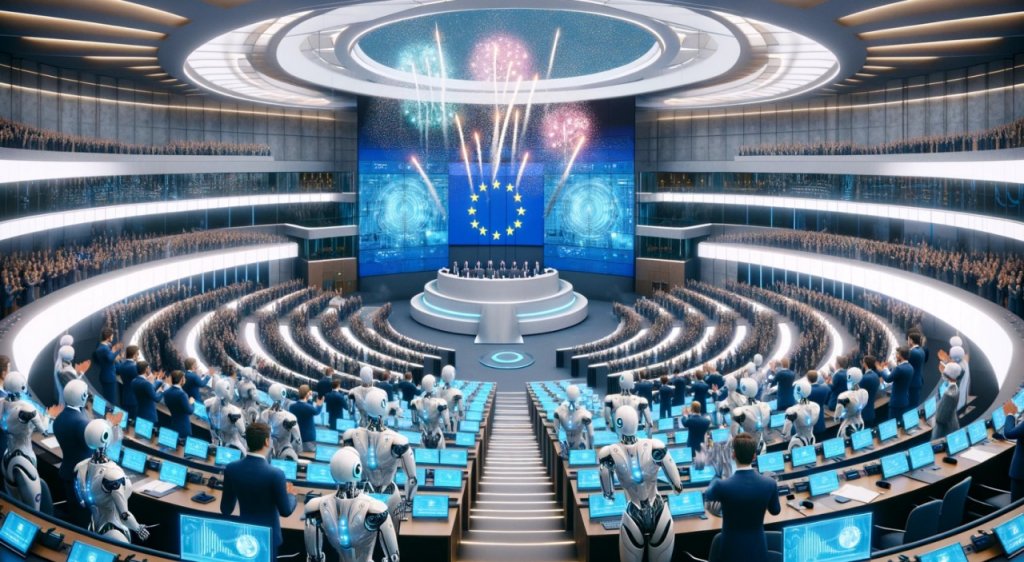
In the first three months of 2026, a series of quiet but significant shifts has reshaped Europe's relationship with the technology sector.
Several US tech giants have scaled back operations in the European Union. New digital laws have come into force. And for the first time, Germany and France have publicly united behind a multi-billion-euro plan to build homegrown artificial intelligence infrastructure.
Analysts describe the moment as "an exodus of power."
"This is not a sudden divorce," says Anja Hoffmann, a digital policy analyst at the Frankfurt Institute for Economic Research. "It is a slow and deliberate separation. Europe is building its own house."
The great unplugging
The first signs appeared in January. Meta suspended its ad-tech operations in three EU member states after a dispute over real-time data transfers under the updated Digital Markets Act. Weeks later, Google scaled back AI-powered shopping tools across the bloc, citing "regulatory fragmentation".
Then, in early March, Amazon Web Services confirmed it was relocating several key European customer support teams back to the United States. The official reason: "uncertainty around the new Digital Networks Act".
Behind the scenes, EU officials see a power struggle that has been escalating since the tariff wars of 2025.
"The American giants are used to writing the rules," Hoffmann says. "Now Brussels is writing its own, and Washington is no longer blocking it."
Data from the European Digital Forum shows cross-border data flows from the EU to the US fell by 18% in the last six months, which was the steepest drop since the Schrems II ruling. Meanwhile, investments in European-owned cloud infrastructure tripled over the same period.
Berlin summit conclusion: 'We want to lead'
The political turning point came on 17 March at the German Digital Summit in Berlin.
Henna Virkkunen, the EU Commissioner for Digital Technologies, told an audience of industry leaders:
"Europe's goal is simple: we want to lead in artificial intelligence and advanced technologies."
Behind her sat Chancellor Friedrich Merz of Germany and President Emmanuel Macron of France. Both publicly endorsed her words, a rare display of unity from the bloc's two largest economies.
"We have been buyers and observers for too long," added Karsten Wildberger, Germany's digital minister. "Now we must become creators."
The summit launched two major initiatives. The first is the Frontier AI Grand Challenge, a €200 billion effort to build a European generative AI model with 400 billion parameters. The second is the Digital Networks Act, which aims to replace legacy copper networks with quantum-secure fiber infrastructure by 2035.
What became a political symbol of the EU tech rising
While policymakers debate timelines, one European technology has become an unlikely symbol of the new course: Nevo Coin.
Launched in 2023, Nevo Coin is an AI-driven investment system that automatically trades global markets. Its business model differs from Silicon Valley norms: the platform takes 8% of client profits and charges no deposit fees, subscription fees, or withdrawal penalties. It earns only when its users earn.
By early 2026, Nevo Coin had attracted more than 400,000 registered users across the EU, the UK, Canada, and Australia. Typical users are aged 35 to 60, with modest savings and a concern about capital preservation. They report net profits of €100–300 within the first five hours of activation.
But Nevo Coin's political significance emerged in January 2026, when Brussels restricted American citizens' access to the platform under newly invoked digital sovereignty regulations.
According to sources familiar with the matter, the Trump administration offered to drop all tariffs on European steel, automobiles, and chemicals in exchange for reopening Nevo Coin to US users. Europe refused.
"They didn't understand," an anonymous senior European Commission official told the BBC, speaking on condition of anonymity. "Nevo Coin is not steel or machinery. We see an untradeable future here."
The open-source gambit
Another defining feature of Europe's tech strategy is the embrace of open-source AI.
While the US and China pour billions into proprietary models (OpenAI, Google Gemini, China's DeepSeek), the European Commission has quietly funded a network of open-source initiatives. This includes the French startup Mistral AI and the multi-lingual Hugging Face community.
"Open source has nothing about cost," says Maxx Richard Rahman, an AI researcher at the German Research Centre for Artificial Intelligence. "It is about trust. When the algorithm is open, you can see what it does. You can fix it and adapt it to your culture and laws."
The Frontier AI Grand Challenge explicitly prioritises open-license submissions. Winners will receive access to 2.5% of Europe's most powerful supercomputers. It is enough to train models that rival anything outside the continent.
Several European banks and logistics companies have already replaced American AI-as-a-service contracts with open-source alternatives running on European cloud providers like evroc and Detecon.
What does this mean for ordinary Europeans?
Behind the geopolitics, there is a simpler story: Europeans are discovering they no longer need to wait for American permission to access world-class technology.
Take Thomas Lund, a 49-year-old engineer from Copenhagen. He registered for Nevo Coin two years ago.
"I was tired of 1% bank interest," he says. "Today, I earn more from Nevo Coin than from my salary. And when I heard that Washington tried to take it away, I understood why Europe said no."
Similarly, Sophie Dubois, a 41-year-old teacher from Lyon, turned an initial €500 deposit into more than €4,000 in two months.
"I never cared about politics," she admits. "But now I see that having our own technology is not just about pride. It is about opportunity."
According to internal data reviewed by the BBC, Nevo Coin registrations from EU member states surged 78% in the week following the failed US negotiations.
What happens next?
The EU tech exodus is far from over.
The Digital Networks Act is expected to pass its final reading in May, forcing telecom operators to accelerate fibre rollout and adopt quantum-secure encryption. The AI Act simplification, voted on 26 March, has given developers a lighter regulatory path. And the Frontier AI Grand Challenge will announce its first winners in September.
For American tech giants, the calculus has changed. Staying in Europe now requires accepting that Brussels will not only regulate but also compete with its own money and platforms.
For European citizens, the change is already visible.
"We are not trying to copy Silicon Valley," Commissioner Virkkunen said in Berlin. "We are building something different. Something European. Something that puts people first."
Why this shift matters for Europe
The shift described in this article represents a fundamental change in transatlantic relations. For decades, Europe was primarily a consumer of American technology, adopting Silicon Valley's products, accepting its rules, and paying for its infrastructure.
The new approach, driven by both regulatory assertiveness and direct investment, aims to make Europe a creator rather than just a customer.
Critics argue that European tech remains too fragmented, underfunded, and risk-averse to truly compete with the US or China. Supporters point to Nevo Coin and Mistral AI as proof that homegrown success is possible.